



Customizing Coarse Calcium Carbonate Specifications for Industrial Buyers
Learn how to customize coarse calcium carbonate for industrial applications: particle size, whiteness, moisture. Tailored custom calcium carbonate for your needs.
https://tankymineral.com.vn/customizing-coarse
Customizing Coarse Calcium Carbonate Specifications for Industrial Buyers
Coarse-grade calcium carbonate (CaCO₃) plays a key role in industries such as construction, plastics, paints, rubber, animal feed, and chemicals. Each sector requires specific input parameters—particle size (coarse mesh), whiteness, moisture, and purity.
This drives demand for custom calcium carbonate, a solution that allows CaCO₃ to be tailored to exact technical requirements, ensuring optimal efficiency and cost control.
Why Industrial Buyers Need Custom Calcium Carbonate
1. Enhanced production efficiency
Every production line requires a specific coarse or fine grade. Incorrect sizing can lead to poor performance, wasted materials, and increased production cost.
2. Consistency in final product quality
For example:
Paint requires high whiteness
Plastics require uniform particle size
Construction materials require hardness and stability
By customizing coarse mesh, manufacturers receive exactly the grade that matches their application—no blending required.
3. Cost optimization
Instead of using a high-grade, overly refined CaCO₃ that exceeds actual needs, buyers can order the perfect-fit grade and save 10–30%.
Customizable Parameters in Industrial Grade CaCO₃
1. Particle size (Coarse Mesh)
This is the most common requirement. Options include:
5–10 mesh – concrete, mortar, construction
20–60 mesh – industrial products, surface processing
100–200 mesh – plastics and rubber requiring coarse but uniform particles
>200 mesh – still available upon request (fine grade)
Customization includes:
Narrow-cut size distribution
Controlled fine-powder content
2. Whiteness Level
Used in:
Paints
Plastics
Putty powder
Paper
Typical customizable whiteness ranges:
90–92% – general industrial use
93–95% – industrial grade CaCO₃ for plastics/rubber
96–98% – premium grade for paint and coating
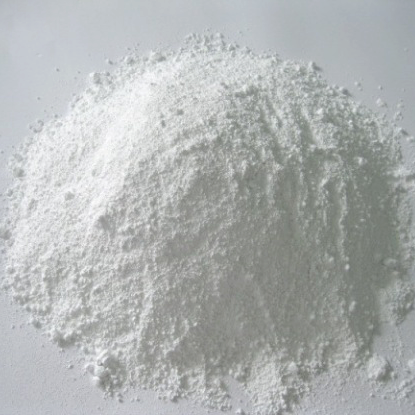
3. Moisture Level
Moisture directly affects storage and dispersion. Typical specifications:
≤0.2% – plastics, rubber
≤0.5% – putty and dry-mix materials
≤1.0% – general construction
Lower moisture prevents:
caking
poor dispersion
incompatibility with polymers
Production Process of Customized Coarse Calcium Carbonate
1. Raw material selection
High-purity limestone (CaCO₃ ≥ 95%), preferably from bright-white quarries.
2. Primary crushing
Rocks are crushed to 20–50 mm for further processing.
3. Coarse grinding
Hammer mills, jaw crushers, or roll mills reduce material to 5–200 mesh.
4. Particle classification
Vibrating screens or air classifiers ensure uniform sizing and eliminate oversize or overly fine particles.
5. Whiteness & moisture control
Drying processes reduce moisture; whiteness is checked and stabilized before packing.
6. Packaging
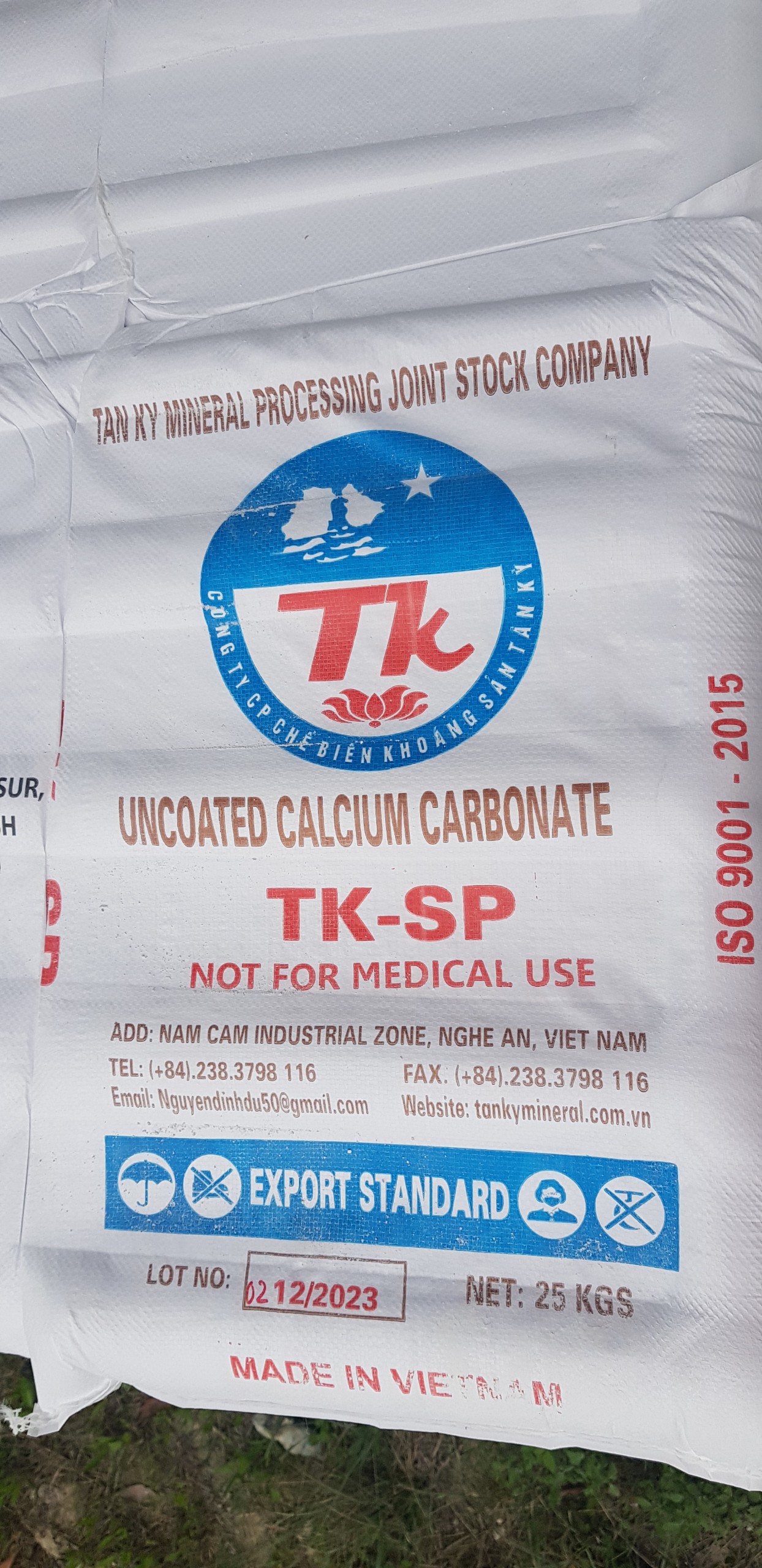
Available in 25 kg / 50 kg PP bags or 1-ton jumbo bags.
Applications of Customized Coarse Calcium Carbonate
Plastics & Rubber
improved rigidity
cost reduction in polymer consumption
dimensional stability
Paints & Coatings
whiteness enhancer
improved opacity
smoother finish
Construction Industry
terrazzo tiles
dry-mix mortars
lightweight concrete
decorative materials
Animal Feed
mineral supplementation
moisture regulation
improved digestion
Benefits of Ordering Custom Calcium Carbonate
Full control over coarse mesh particle size
Consistent and reliable quality
Reduction in waste and downtime
COA and MSDS support
Packaging tailored to logistical needs
