


Can Limestone Powder Replace Part of Cement in Concrete? A New Anti-Corrosion Solution for Coastal Projects in the Philippines
Explore how limestone powder (CaCO₃) can partially replace cement to improve durability and saltwater resistance in Philippine coastal and island construction projects.
https://tankymineral.com.vn/can-limestone-powder-replace
Can Vietnamese Limestone Powder Become an Anti-Corrosion Additive for Concrete in the Philippines?
With more than 7,600 islands, the Philippines has one of the highest densities of coastal infrastructure in Southeast Asia. Ports, roads, bridges, airports, and resorts built along the shoreline constantly face:
Chloride corrosion from seawater
Rising cement prices
The need for more durable materials in marine environments
Because of these challenges, engineers in the Philippines have begun experimenting with limestone powder (CaCO₃) as a partial replacement for cement. This approach is already common in Europe and is now emerging in Southeast Asia—especially in countries with large coastal construction needs.
The key question is:
Can high-quality Vietnamese limestone powder become a strategic anti-corrosion additive for Philippine concrete?
Let’s explore the science, benefits, applications, and market potential.
Limestone Powder – A Rising Global Trend in Concrete Technology
Limestone powder (Ground Calcium Carbonate – GCC) is widely used in:
Cement production
Mortar and plaster
Concrete mixes
Block and paver manufacturing
Modern research shows that CaCO₃ does more than act as a filler. It helps:
Increase early-age strength
Improve packing density of concrete
Reduce pore volume
Enhance resistance to chloride penetration
These advantages make limestone powder especially valuable for marine and coastal construction—an area where the Philippines has major demand.
Production Process of Construction-Grade CaCO₃
Below is the standard process used by leading Vietnamese manufacturers:
High-purity limestone mining
Materials are sourced from white limestone mountains with CaCO₃ content ≥ 97–98%.
Crushing & impurity removal
Magnetic separators eliminate heavy metals and impurities.
Fine grinding
Typical particle sizes for concrete are:
8–20 microns → high-performance concrete
20–45 microns → ready-mix concrete
→ high-density, low-porosity concrete
Particle size classification
Air classifier systems ensure tight particle size distribution.
Quality control
Checks include brightness, moisture, purity, fineness.
Packaging & shipment to the Philippines
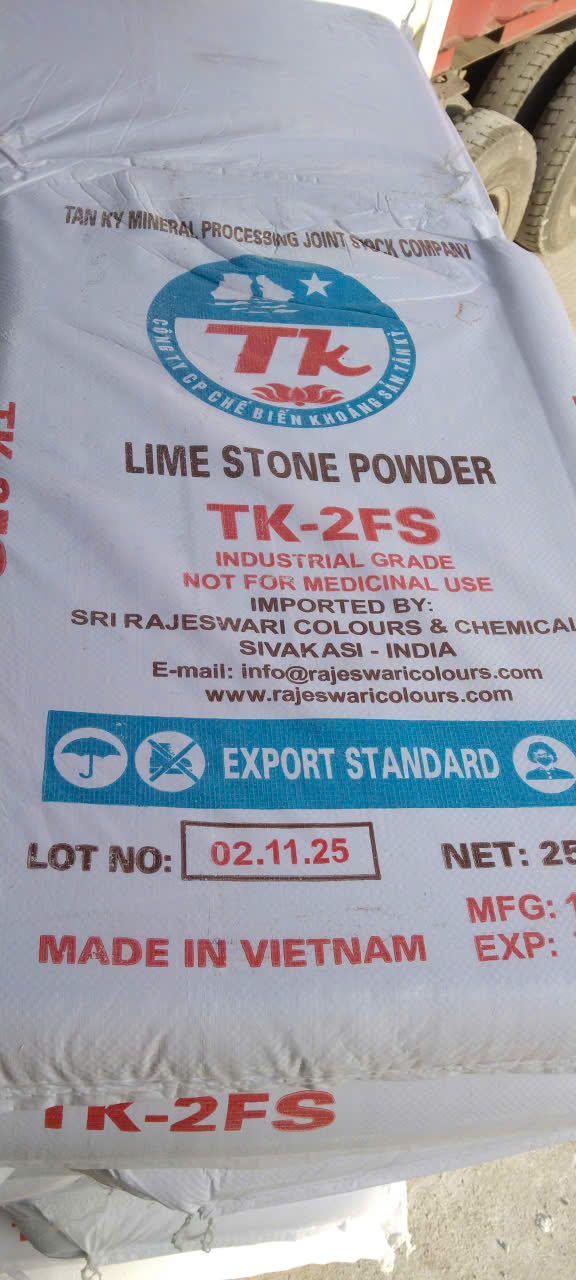
25 kg bags or 1–1.35 ton jumbo bags shipped to Manila, Cebu, Davao within 5–8 days.
Why Can Limestone Powder Replace Part of Cement?
“Filler Effect” – Improves concrete density
Fine CaCO₃ particles fill micro-voids between cement grains, creating a:
Denser matrix
Lower capillary porosity
Reduced water and chloride penetration
This is a major benefit for marine structures.
Accelerates early hydration
Limestone powder works as a nucleation site, helping cement hydrate faster and gain early strength.
Reduces heat of hydration
Ideal for island or offshore projects where temperature control is critical to avoid cracking.
Cuts cement consumption by 10–20%
This is especially important in the Philippines where large volumes of clinker and cement are imported.
Applications in Philippine Marine & Coastal Projects
Limestone powder is being tested in several types of projects:
Ports and wharves
Seawalls and breakwaters
Coastal roads
Beach resorts and island villas
Bridges and piers
Pilot projects in Cebu, Davao, Manila Bay, Coron, and Palawan have tested 5–15% cement replacement.
Preliminary results show:
Stronger resistance to chloride attack
Smoother, denser surface texture
Lower permeability
Reduced cracking
More cost-efficient concrete mixes
Better long-term durability near seawater
This positions CaCO₃ as a promising eco-friendly additive for the Philippines.
Why Vietnamese Limestone Powder Fits the Philippine Market
✔ 1. High purity and whiteness (≥ 97%)
Ideal for visible structures like beachfront resorts.
✔ 2. Consistent particle size distribution
Critical for achieving predictable concrete strength.
✔ 3. Lower price vs. Turkey and China
Vietnam–Philippines shipping routes are short and affordable.
✔ 4. Large, stable supply
Vietnam is Southeast Asia’s largest CaCO₃ exporter.
✔ 5. Compliance with international standards
ASTM – EN – ISO (varies by manufacturer).
Because of these advantages, Philippine importers increasingly prefer Vietnamese CaCO₃ for both concrete and other industries.
Challenges & Considerations When Using CaCO₃ in Concrete
Not all limestone powder is suitable for cement replacement. Engineers must consider:
Particle size – too coarse reduces strength
Moisture content – affects water demand
Shape and texture – irregular particles reduce density
Impurities (MgO, SiO₂) – can weaken concrete
This is why many contractors in the Philippines prefer suppliers with Air Classifier Technology to ensure quality and consistency.
Future Outlook – A New Material Trend for Philippine Construction
With increasing investment in:
Coastal highways
Airport expansions
Port modernization
Island tourism infrastructure
Flood protection and seawalls
The Philippines will require millions of tons of durable, anti-corrosion concrete.
Limestone powder is a cost-saving, performance-enhancing, marine-grade additive that aligns perfectly with the country’s construction challenges.
Vietnam, with its abundant limestone reserves and advanced processing technology, is positioned to become the Philippines’ top CaCO₃ partner in this sector.
.jpg?1764830841740)
The idea that “Vietnamese limestone powder can become an anti-corrosion additive for concrete in the Philippines” is not just theoretical—it's highly practical and increasingly supported by real-world applications.
By replacing 5–15% of cement, CaCO₃ can:
Improve durability
Boost chloride resistance
Reduce cracking
Lower construction costs
Extend the lifespan of marine structures
This makes limestone powder a game-changing material for the Philippine construction market in 2025 and beyond.
- Contact: salesmanager@tankymineral.com.vn
Website: www.tankymineral.com.vn
